
Fredericksburg Property Tax Record Fields
Fredericksburg property tax records have two halves. The Commissioner's land book holds the parcel, the owner of record, and the assessed land and improvement values. The land book also shows the improvement values. The Treasurer's account covers the fiscal-year tax bill, its installments, payments, and penalties. A printed notice can lag behind a recent payment. Read each field against its own date. Save the GPIN and the tax year beside every amount. Note which office supplied the data. If a name or address differs between the land book and the bill, ask which field marks the assessment owner. Ask, too, which is simply the payment mailing contact.
Mapping sits outside the tax system. FredGIS can help you find a GPIN. But the City states plainly that tax information is not displayed in GIS. The parcel key is what ties the two systems together. Carry it across and always record the tax year next to any figure.
| Field | What It Shows | Where |
|---|---|---|
| Owner and parcel | Land-book name and GPIN cross-reference | Commissioner of the Revenue |
| Land and improvements | Components of the total assessment | Commissioner of the Revenue |
| Relief or credit | Elderly/disabled relief, rehabilitation credit, land-use program | Commissioner’s real-estate section |
| Tax year and bill | Installment, due date, payment, and balance | Treasurer portal |
| Penalty status | Late charge and collection status | Treasurer account |
Assessed value is the City's number for taxation. It is not what a buyer will pay. A tax bill builds on the assessed base, applies the rate, and folds in any eligible program or account adjustment. A deed's consideration field, where shown, describes a recorded transaction. These figures differ because each is created for a different purpose at a different moment.
Fredericksburg Assesses at Full Market Value
Real property in Fredericksburg is assessed at 100 percent of fair market value. That standard does not mean every parcel gets an individual appraisal from a recent sale. The Commissioner maintains the land book with land and improvement components. The Commissioner may also issue interim assessments between general cycles. Property cards and reassessment worksheets can be requested by parcel through the Real Estate section. Asking for the worksheet shows which characteristics were applied to your appraisal.
The 2024 general reassessment used market evidence through January or February. Property visits ran through February. The City also cautions that distressed or atypical sales may not represent ordinary value. The office publishes no posted fee for a card request. Confirm the current request and delivery method before ordering a large file or a certified copy.
Mark your calendar by cycles. The 2024 reassessment took effect July 1, 2024. The next full reassessment is expected to take effect July 1, 2028. An annual land-book update is not a citywide revaluation. When a number changes, note the assessment year. Note whether it came from a general cycle or an interim change.
Fredericksburg Tax Lookup by Parcel
Start with the Parcel ID from the current parcel record. Choose the same year printed on the notice. The Treasurer's Real Estate Research form asks for both a Parcel ID and a tax year. Enter both before deciding the account is current, since a different tax year can show a different installment history. The form is not an owner-name search, so begin in FredGIS when the parcel key is unknown.
Mapping helps, but only up to a point. FredGIS can locate a GPIN. Only the tax account gives installment and payment detail, so the two tools are not interchangeable. If a historical TaxMap fails, compare it with the current GPIN. Then call the Treasurer with both identifiers in hand. The City lets owners view, print, and pay a bill online when a mailed tax bill goes missing. Payments are routed to InvoiceCloud. Keep the account period in your notes so an older balance is never mistaken for a current obligation.
| Parcel ID | Use the GPIN or parcel reference tied to the tax account. |
|---|---|
| Tax year | Select the year under review, not just the newest screen. |
| Bill status | Compare installment, payment, penalty, and balance fields. |
| Payment route | Online payment continues through the City’s InvoiceCloud service. |
The Fredericksburg Real Estate Research form is the starting point for a parcel-and-year lookup.
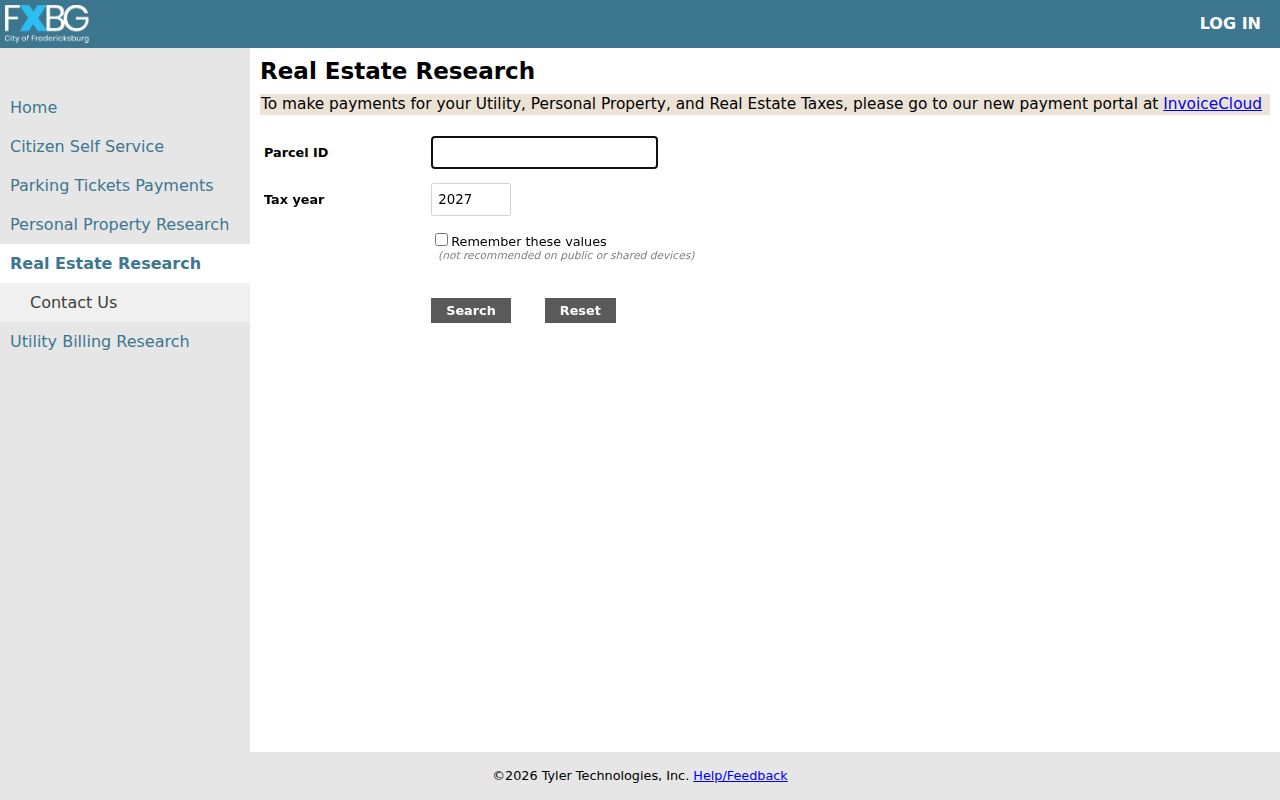
Note: Keep the receipt or payment reference with the year-specific bill so later questions use the same account period.
Rates and Due Dates in Fredericksburg
Fredericksburg sets its real-estate tax rate for the fiscal year running July 1, 2026 through June 30, 2027 at $0.84 per $100 of assessed value. Another $0.01 per $100 is added for fire tax. Do the math on a sample. A $100,000 assessment bills at $840 plus $10, before credits, relief, penalties, or other account-specific adjustments. That arithmetic illustrates the rate only. It does not replace the actual Treasurer bill.
A rate is not a value estimate. The assessed amount on the parcel drives the bill. The City's account record shows what was billed for that property. A balance can shift because of the assessment, the rate, or the account status. So confirm the fiscal year before comparing rates or balances across years.
Payments fall due June 5 and December 5. When a date lands on a weekend or holiday, the next business day applies. The City posts a 10 percent penalty after a missed installment. The Treasurer's page carries the applicable year and current payment channel. A printed schedule or old receipt may not match a later bill. A delinquent status raises collection questions. It is not proof that a tax sale took place. Check the City's Real Estate Taxes page for the rate and cycle details.
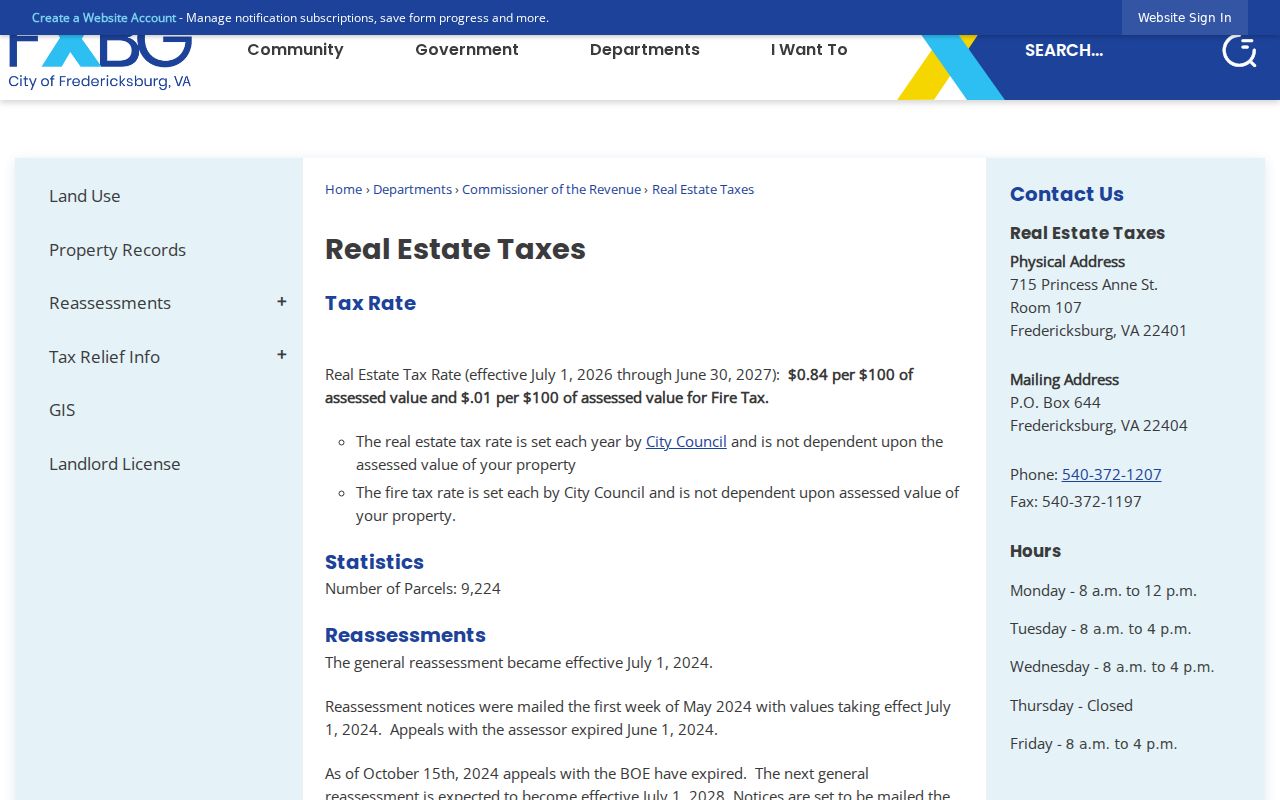
The City’s real-estate tax page is the current reference for dates and rates.
Find a Fredericksburg Tax Bill
Finding a Fredericksburg property tax record starts with the right key. The Treasurer points users to an online parcel-and-year lookup and to InvoiceCloud for payment. Open the bill view by parcel number, not owner name. A bill mailed to a prior owner or another address still belongs to the parcel. Searching by the envelope name can mislead.
With only a street address, use the City map first to identify the GPIN. The tax year matters too. Keep a separate note for each billed period. Then compare the installment and payment entries on that year's account. Keep the receipt with its tax year and installment. If the portal and the notice disagree, ask the Treasurer whether a payment is pending or was applied to another period before paying again.
- Locate the parcel in FredGIS and copy the GPIN exactly.
- Open the Treasurer’s Real Estate Research form and enter Parcel ID and tax year.
- Read each installment, payment, penalty, and balance entry for that year.
- Check the Commissioner’s land book for the assessment and any relief program entry.
- If a tax notice is disputed, call the Treasurer using the City’s published contact information.
- Assessed value
- The Commissioner’s value used as the base for local real-estate tax.
- Tax rate
- The amount charged per $100 of assessed value; the City also posts a fire tax.
- Relief program
- A local program such as elderly/disabled relief, rehabilitation credit, or land use; ask the Commissioner about its rules.
- Tax lien
- A claim associated with unpaid taxes; confirm status with the Treasurer and search recorded instruments where needed.
Fredericksburg Relief Programs
Fredericksburg relief programs take three main forms, and each has its own rules. The Commissioner of the Revenue's Real Estate section handles three duties. It administers elderly and disabled tax relief, a rehabilitation credit, and land-use assessment. Eligibility thresholds, application forms, and renewal calendars are not fixed across programs. Contact the Commissioner for the application and current deadlines. Do not borrow another locality's income limits.
Never assume an exemption transfers with a sale. Relief does not attach automatically to a new owner of record. A program appearing on a neighboring account or an older land-book entry proves nothing about your parcel. Keep the approval notice and its effective year. Then verify the relief appears in the account period on the tax roll.
When asking about a relief record, provide the GPIN and the assessment year. Ask whether the program changes assessed value, taxable treatment, or the amount billed. Ask also which office handles renewal. The land book and the Treasurer account serve different roles. Check both if the bill does not reflect the expected relief. The Treasurer confirms billing, while the Commissioner handles assessment and program status.
Fredericksburg Appeal Route
The 2024 reassessment cycle in Fredericksburg traced a two-step appeal route. A reassessment notice could go to the Commissioner for review first. It could then move on to the Board of Equalization. The assessor appeal window ran May 20 through June 1, 2024. The Board of Equalization filing date was October 15, 2024. Those dates are historical. They are not current filing instructions. For a later assessment, use the dates printed on the notice. The City's Reassessments page also carries current information.
Strong evidence speaks to the parcel and the valuation date. Gather the assessment notice, the property card, and recent comparable sales the City considered relevant. Also document features that affect value. The 2024 materials say assessors studied sales and visited properties through February. They used market data through January or February. Distressed or atypical sales may be excluded. Ask for the worksheet if a value component is unclear.
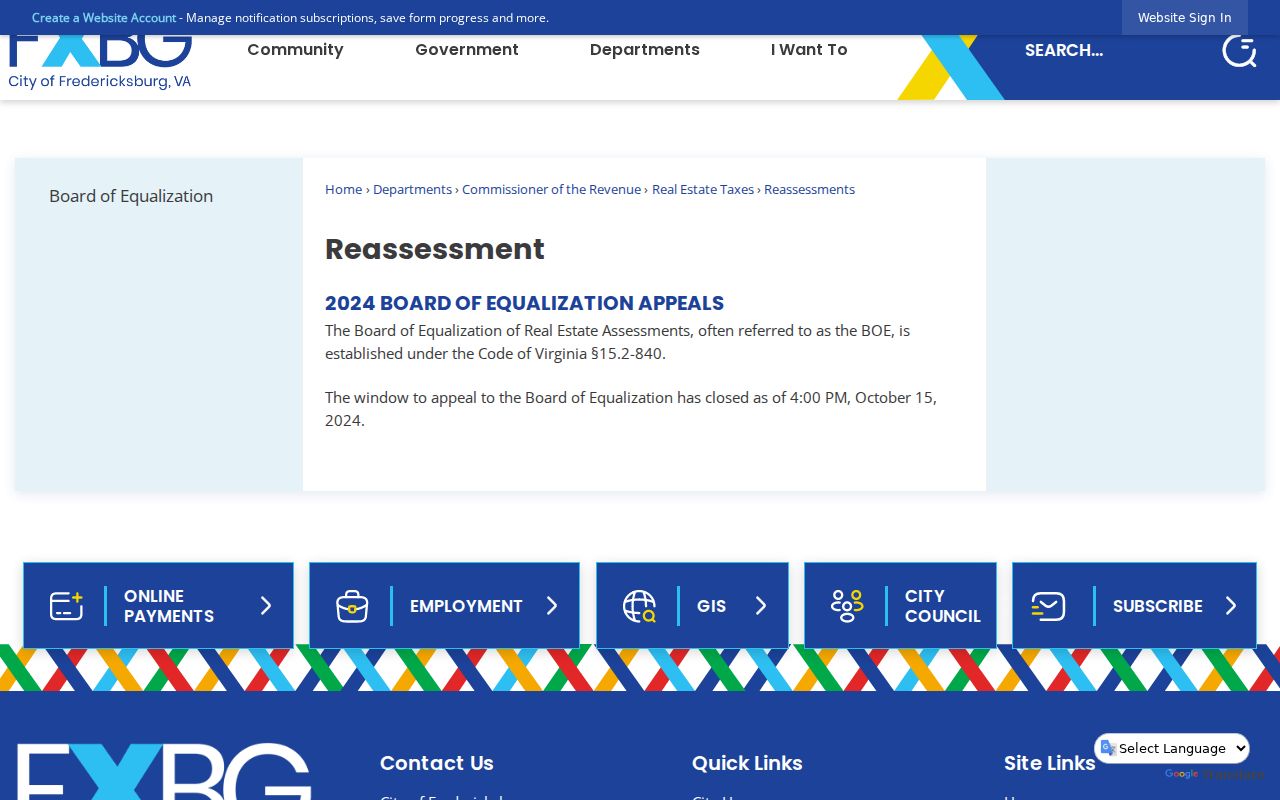
The Board's page lays out how appeals reach it, though the current notice governs which cycle applies and when filings are due.
Delinquency and Tax Sale Evidence
A delinquent amount shows an unpaid balance. It does not, by itself, prove a tax sale happened or that title passed. A late charge, lien, or collection notice can sit on the account. The parcel can stay with the owner of record the whole time. Before assuming any transfer, keep the tax-account trail and the deed chain apart. Check payment history with the Treasurer first. Then, if a transfer is alleged, look for the recorded deed. Or look for the court record behind it.
The city publishes no current delinquent-tax list, tax-sale calendar, or local foreclosure publication outlet. So a delinquent flag means collection activity, nothing more. Pull the Treasurer's account for the actual balance. After that, search the Circuit Clerk's land index and court docket for the paper that matters. That paper may be a lis pendens, a sale notice, a trustee's deed, a commissioner's report, or a final order. Fredericksburg property records answer ownership questions through those instruments, not through the tax bill alone.
A distressed sale is said to have changed ownership. Confirm it with the recorded trustee's deed or a court-confirmed transfer. An advertisement proves nothing about whether the sale closed. A tax lien or a court filing does not convey a parcel either. Treat the tax account, the docket, and the land instrument as three separate records. Note each one's date and source name so the deed records tell a clean story.
Appeal a Fredericksburg Assessment
An appeal works best as an evidence packet. It is not just a feeling that the value is too high. Gather the notice, the GPIN, and the correction you want. Add the property card plus dated sales or condition facts tied to the assessment period. Fredericksburg's 2024 study counted transactions through January or February. Property visits ran through February. Some distressed or atypical sales could be excluded. Ask the Commissioner to explain any worksheet component. Confirm the current filing route and deadline before you submit anything.
The appeal path runs through the reassessment notice and the Board of Equalization. File with the office named there. File by the date named there too. The 2024 schedule is a record of that cycle, not a deadline for later years. The city expects the next full reassessment to take effect in 2028. But a current notice with an appeal period should not wait for that cycle.
Appeal window. Use the filing date on the current Fredericksburg notice and confirm any Board of Equalization step with the City. The published 2024 dates have passed and should not be reused as a present deadline.