
Find Who Owns a Fredericksburg Property
Start by deciding what "owner" means for your question. The Commissioner's land book carries the name tied to assessment. The newest deed in the Circuit Court Clerk's index names the recorded grantee. The Treasurer's tax records show the account and payment period. These property records can disagree with each other. That happens during a recent transfer. It also happens when a trust or company holds title.
The dependable route for who owns a property in Fredericksburg begins with the situs address. A broad name search will not get you there. FredGIS locates the parcel and supplies the GPIN. The GPIN becomes your key across offices. The land-book entry gives the owner of record plus assessment context. The latest deed identifies the grantee named in the instrument. When names disagree, compare the recording dates. Then ask whether the land book has caught up with the deed yet.
- Locate the situs address in FredGIS and copy the GPIN and legal-description field.
- Search the Commissioner’s land book by owner or parcel and note the owner-of-record name and assessment year.
- Search the latest matching land instrument through Virginia SRA and compare the grantee and legal description.
- If an LLC appears, use the Virginia SCC Clerk’s Information System to identify filed entity details, while treating the deed as the property transfer record.
- Keep the tax mailing address separate from the situs; use it only for a lawful property matter.
Fredericksburg Owner Sources Compared
Each source answers a different question. FredGIS locates the parcel and opens owner, GPIN, MAPID, and zoning search paths. The Commissioner maintains the land book and can issue a property card. The Treasurer looks up a parcel by tax year. The Clerk records the deed itself. The state business registry can confirm a company's status and registered agent. But it will not tell you who owns the local parcel.
Several Fredericksburg systems will show you a name. Their records do not carry equal weight, and they update on different schedules. Match each one to the question at hand. Keep the result labeled with its source so an assessment name never gets presented as a verified deed grantee.
| Source | Owner Information | Access and Timing |
|---|---|---|
| Commissioner’s land book | Owner of record, parcel, assessment, and mailing details | FredGIS and office records; public update lag is not specified |
| Circuit Clerk deed index | Grantor, grantee, instrument type, and recording date | Free index where enabled; images may require subscription or Clerk access |
| FredGIS parcel layer | Owner search mode and GPIN, address, map, zoning context | Public viewer; tax data is not in GIS |
| Virginia SCC CIS | LLC or corporation status and filed agent information | State entity channel; not proof of land title |
A name returned by one system could be the owner of record, a deed grantee, an entity agent, or a mailing contact. Know which role the field describes before you rely on it.
The Treasurer's Real Estate Research form is the parcel-keyed lookup tool for tax records.
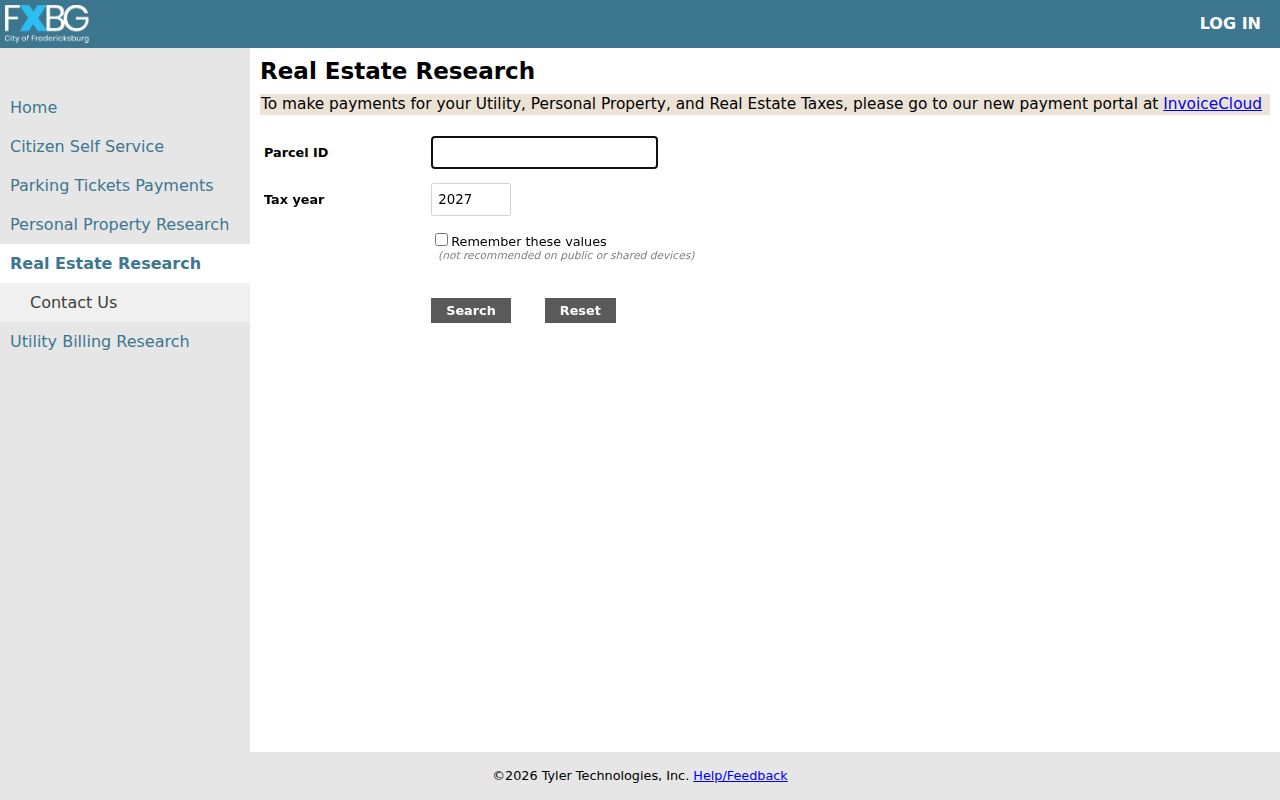
The separate parcel and name paths keep a bill lookup from being mistaken for an ownership record.
GPIN Links a Fredericksburg Owner Search
A GPIN lets you follow one parcel across GIS, assessment, tax, and land records. Copy it exactly, and keep any TaxMap or MAPID shown alongside it. Fredericksburg requires the GPIN on the first page of land recordings and on two lines of the ILS coversheet, which makes it a practical bridge between the latest deed, the Commissioner's parcel entry, and the GIS polygon. It remains an administrative key, though, not the legal description. Historic tax-map labels sometimes changed during GIS conversion, so compare the deed text and keep both forms when they differ.
One City example shows A19-84A becoming GPIN 7860-90-3994. That conversion is documented for that parcel only. It illustrates why older records can fail under a current-number search, and why you should compare the legal description and address before treating an old and new number as the same property.
If an owner result looks wrong, check whether it belongs to the older or newer parcel key before assuming a different property. A deed may describe several lots, a life estate, or an easement that a one-line GIS result will not reveal.
Owner and Situs Addresses Differ
The address on the map locates the property itself. A bill or land-book mailing address may instead be the owner's home. It may also be an agent, or a lender. A mismatch does not mean you found the wrong parcel. Compare GPIN, legal description, and owner name across records. Label each address by its purpose in your notes. Never use a mailing address as proof of residence. Never use a situs address as the owner's contact information.
The situs is where the Fredericksburg property physically sits. The mailing address is where the owner asks the City to send tax notices. That address may be outside the city or state entirely. A tax bill addressed to an out-of-area recipient does not move the parcel. Likewise, the street address in PropertyAddress is not necessarily a current mailing destination.
For a routine ownership question, keep the two addresses as separate fields. Resist inferring a residence from either. A name on the tax roll may belong to a trust, LLC, executor, or co-owner. A mailing address helps with formal notice or a transaction. But it says nothing about who lives at the site.
Fredericksburg LLC and Trust Owners
A deed in Fredericksburg property records can vest title in an LLC, corporation, trustee, or estate fiduciary. Rather than a person, the recorded instrument controls. Read it to see which entity or trustee actually received the interest. And check whether the parcel is affected in whole or in part. Do not assume a registered agent, signer, or contact person personally owns the property.
For an LLC or corporation, the State Corporation Commission's Clerk's Information System adds useful context. It shows status, formation date, registered agent, principal office, and filed officers or managers. That detail explains a name and contact trail. It does not replace the grantee printed on the deed. And it does not establish title to the parcel.
Trusts raise one more wrinkle. Trust instruments may be private or only partly visible in the public record. So search the exact vesting name and any trustee named in the deed. An executor's or administrator's deed should be read alongside the Circuit Clerk's estate record. Try punctuation variants of the entity's legal name, too. What matters is the recorded deed, not the trail of contact names around it.
Recent Deeds and the Fredericksburg Roll
A newly recorded deed can outrun the Commissioner's owner field. After closing, the deed record and the land book may not show the new grantee at the same moment. The deed may record first. Fredericksburg budget material describes a monthly transfer review, but that is not a guaranteed update deadline for each parcel. A monthly review is not a promise. Every sale may not hit the roll within a set number of days. When a transfer is recent, compare the recording date and grantee in SRA with the assessment entry. Then ask the Commissioner whether the land book reflects it yet.
For the freshest conveyance, go to the Clerk's index and inspect the actual instrument. Do not wait for a map label to change. Compare the deed's recording date against the assessment year or effective date on the entry.
For the present owner-of-record field and how to confirm it, see the Fredericksburg current owner record. For a title question, rely on the deed itself and its cited prior instrument. Do not extrapolate from a tax screen.
VADeed Alert for Fredericksburg Owners
The Circuit Court Clerk introduced a free, voluntary VADeed Alert service in March 2026. It emails an enrolled name or Tax Map/Parcel ID when certain land documents are recorded. It can flag an unexpected filing early. It cannot block a document, and it cannot decide whether a filing is legitimate. An alert is a prompt, not proof. Open the matching instrument in the Clerk's index. Compare its type, date, parties, and GPIN before treating the notice as meaningful evidence of an ownership change.
Enrollment instructions are on the City's Clerk page and the state Courts login. Enroll through the official VADeed Alert login. Keep the enrollment confirmation. Note the exact spelling and parcel key you enrolled, since either can change. If an alert is unfamiliar, contact the Circuit Clerk using the published number. Never use a number from a suspicious notice.
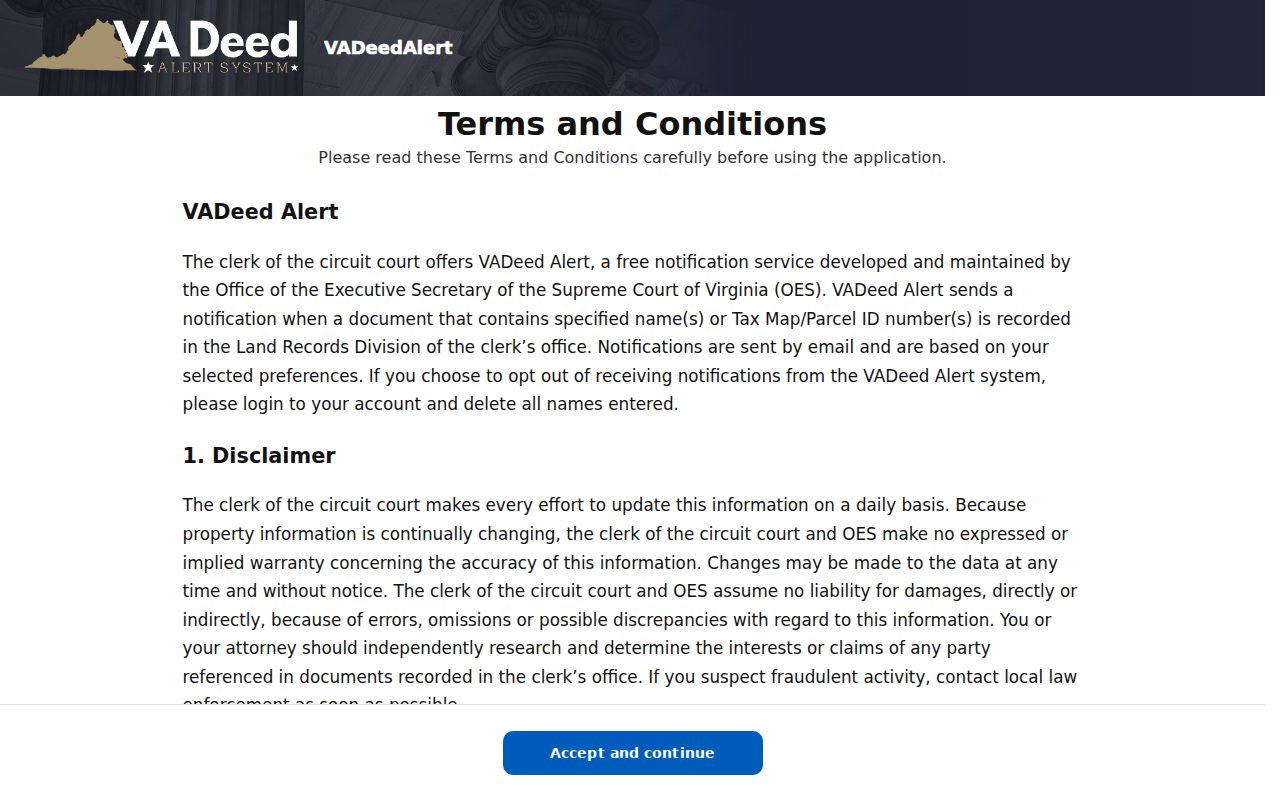
Alerts are prompts to verify the recorded document, not a replacement for reviewing it.
Fredericksburg Property Owner Records
The Commissioner of the Revenue keeps the records that answer most assessment questions. The property card or worksheet explains assessment characteristics and value. The tax portal shows the bill account. The office at 715 Princess Anne Street, Rooms 102 and 107, handles real-estate assessment. Published hours are Monday 8 a.m. to noon, Tuesday and Wednesday 8 a.m. to 4 p.m., and Friday 8 a.m. to 4 p.m. It is closed Thursday and weekends. Ask about the current request process for a property card.
Several Fredericksburg offices each hold a piece of the answer. The Commissioner's land book names the owner of record used for assessment. The Circuit Clerk's deed index names the parties to recorded instruments. FredGIS can surface a parcel and its documented owner-search mode. But it is not the tax account. The Treasurer's parcel-and-year search answers a bill question. When the GPIN, deed description, and date all match across these sources, the property records line up.
| Source | Owner Info It Gives | Access |
|---|---|---|
| Commissioner | Land-book owner and assessment entry | FredGIS or office request |
| Circuit Clerk | Deed grantee and recorded transfer details | SRA index; image access varies |
| Virginia SCC | Filed entity and registered-agent details | State business search |
| City GIS | Parcel location and map identifiers | Public MapInsights viewer |
Four terms do different work in Fredericksburg property records. Owner of record is the name the assessment record carries. It says nothing about the occupant. The deed grantee is the party named in the transfer instrument. Title is the legal interest conveyed and recorded. Situs is the parcel location. The mailing address is the tax notice destination. Each term describes a separate field or legal role.
Confirm a Fredericksburg Deed Grantee
For a solid owner-of-record result, match the parcel's GPIN and legal description to the newest recorded instrument. Then read the grantee clause and the recording date closely. An index line only points the way. It cannot supply the full legal context. Look for a later correction, partial conveyance, release, or similar instrument. That might change how an earlier deed reads. A gap or a vague vesting clause calls for more digging. Request the document from the Circuit Court Clerk. Bring in a title professional or attorney when the stakes are real.
Sometimes the tax roll and the deed disagree. Sort the Fredericksburg records by date and document type first. A corrected deed, trustee's deed, or executor's deed often explains something. It often explains why a familiar name vanished from the owner field. Note that a deed of trust or a satisfaction never changes the grantee on its own. Read the full recorded image when you can. Check the GPIN, legal description, and any cited prior instrument. That confirms the paper concerns the same parcel.
Access works in tiers. The SRA index may be free to view, while land-record images require Clerk authorization and the applicable fees. No image online? Ask the Clerk about the office copy route. Keep in mind that an index entry is a pointer to the filed deed. It is never a substitute for the transfer language itself.
Limits of a Fredericksburg Owner Search
No owner search tells the whole story. A Fredericksburg lookup cannot surface every beneficial interest. It also cannot surface every unrecorded agreement, occupancy arrangement, or private mailing detail. Use names and address data only for a lawful property-record purpose. Never use it to stalk, harass, threaten, or harm anyone.
A name in Fredericksburg property records is not proof of current occupancy. It is not proof of clear title either. And it may not show the full beneficial ownership behind an entity. These files can hold a mailing address, a signature, or a financial term. Such details deserve careful handling. Virginia address-confidentiality protections and lawful redaction rules may shield certain people. Ask the Clerk or the agency about the proper process. Do not infer a protected address from some other source. For a transaction, get the underlying deed and a professional title review. For an account issue, call the Commissioner or Treasurer. For a boundary, hire a surveyor.
Lawful use. Use a Fredericksburg owner lookup for property due diligence, a boundary or tax question, or house history. Do not use a public name or address to threaten, surveil, repeatedly contact, or harm anyone.